
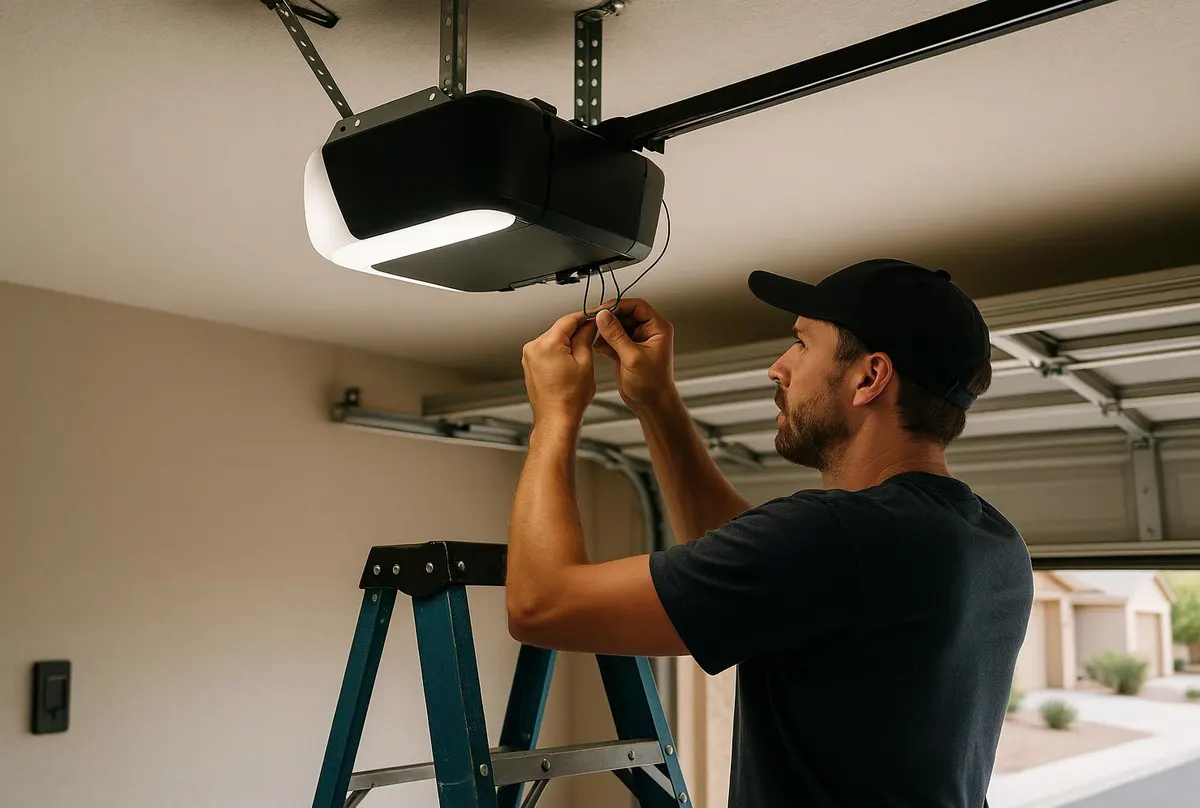
What a Technician Sees After a Storm Rolls Through
After a night of heavy wind and rain, the calls follow a pattern: a door that's bowed inward at the middle panel, track brackets pulled loose from the framing, or a door that won't budge because water got into the opener's circuit board. In a lot of these cases, the homeowner didn't have a dramatic failure during the storm itself — they had a door that was already weak, with worn rollers, loose track bolts, or thin original panels, and the wind just found the problem. By the time we get there, the garage has taken on water, insulation is soaked, and sometimes a vehicle inside has storm damage that could have been avoided.
Why the Garage Door Is a Home's Weakest Wall
Every other wall in a house is a solid, continuous surface tied into the frame. The garage door is the opposite: it's a large moving panel, often 16 feet wide, held in place by tracks, rollers, hinges, and a spring system — not poured concrete or load-bearing studs. When wind pushes against a house, that door takes a disproportionate share of the pressure. If it fails, wind gets into the garage, pressurizes the whole structure from the inside, and can lift the roof or blow out windows on the far side of the house. That's why wind-load ratings exist for garage doors in storm-prone regions, and why a door that looks fine on a calm day can still be a liability in a 60+ mph gust.
Central Florida's storm pattern makes this a real concern, not a hypothetical one. Between the afternoon downpours that build through late summer and the tropical systems that can still spin up through October and into November, garage doors here get tested more often than in most parts of the country.
Signs Your Door Isn't Ready
- Visible bowing or flexing when the door is closed and wind hits it — even mild flexing means the panel or bracing isn't stiff enough.
- Loose or rusted track bolts, especially near the bottom where water tends to collect.
- Worn rollers or stretched cables that let the door rattle in its tracks instead of sitting tight.
- No horizontal struts on the back of the panels — many older doors were never fitted with reinforcement bracing.
- An opener with no battery backup, which means a power outage during a storm leaves you unable to open or close the door manually in a hurry.
Bracing and Reinforcement Options
If your door isn't rated for high wind, there are a few practical paths, each with trade-offs:
- Retrofit bracing kits add horizontal struts across the back of the panels and reinforce the track attachment points. This is the lower-cost option (commonly a few hundred dollars for materials and labor as a general range) and works well on doors that are otherwise in good shape.
- Full door replacement with a wind-rated door makes sense if the current door is older, dented, or the panels are already thin-gauge steel or aging wood composite. This costs more upfront (often $1,000–$3,000+ depending on size and material, as a general range) but solves the problem at the source and usually comes with better insulation and weatherstripping too.
- Track and hardware upgrades — heavier-gauge tracks, reinforced end hinges, and new rollers — matter more than people expect, since a wind-rated panel is only as strong as what's holding it in the opening.
Moisture, Rust, and Swelling
Humidity and salt air in this part of Florida don't just affect coastal homes. Afternoon storms push moist air into garages constantly, and that moisture gets into bottom seals, metal tracks, and spring coils. Watch for:
- Rust starting at the bottom corners of steel doors or on spring coils — a sign springs may fail sooner than their rated cycle count.
- Wood or composite panels that swell slightly and start dragging against the track or weatherstrip.
- Bottom seals that have gone stiff or cracked, letting water pool under the door during heavy rain.
A yearly once-over — lubricating rollers and hinges, checking spring tension, tightening hardware, and replacing worn seals — catches most of this before it becomes a storm-day failure.
Opener Power and Manual Access
Power outages are common during and after bigger storms. If your opener doesn't have battery backup, you're relying on the manual release cord, which only works if the track and rollers are in good condition and the door isn't bowed or jammed. Pairing a reliable opener with working manual access is as much a storm-prep item as the door panel itself.
When to Call Fern Park Overhead Door Co
If you've noticed flexing panels, rust on the springs, a door that drags or sticks, or you're not sure whether your current door has any wind-rated bracing, that's worth a look before storm season peaks rather than after a system is already forecast. We handle garage door replacement for homeowners who need a wind-rated upgrade, and cable & roller replacement for doors that just need their hardware brought up to spec. We'll check the track alignment, spring condition, and bracing, and tell you plainly whether a retrofit or a new door makes more sense for your situation.
If you're in Fern Park, Casselberry, Winter Springs, Altamonte Springs, Longwood, Maitland, Winter Park, or Sanford and want your garage door checked before the next storm rolls in, call Fern Park Overhead Door Co and we'll get a technician out to take a look.